SLDF has successfully implemented or initiated the following projects:
ABSTRACT
Training in India: Manufacture of Sanitary Napkins
The SLDF sent one young woman to Coimbatore for training. The SLDF established a women-led business in Jaffna that manufactures and distributes low-cost, hygienic sanitary napkins. For logistical reasons the unit has been moved to Mankulam. The business employs local women while meeting a need for affordable feminine hygiene products in the region.
Mushroom Farm: Jaffna
In Jaffna, the SLDF has established a mushroom farm on the grounds of an orphanage in Jaffna that is home to 200 children. As in all SLDF projects, participants received training and technical support to learn to cultivate the mushrooms and manage the business.
School Stationary and Supplies: Vanni region
In the Vanni region, the SLDF has provided school stationery and supplies to more than 50 orphaned middle school children.
Horticulture for School Children: Kilinochchi
The SLDF has helped over 100 schools in the Kilinochchi area plant and maintain mango trees on school grounds, to educate children about horticulture and provide fresh fruit for their meals during the school day.
Support for Entrepreneurs: Jaffna and Vanni area
The SLDF has provided start-up materials, supplies, technical assistance and consultation to dozens of individual entrepreneurs. Examples include providing broiler chicks to bolster the business of a semi-blind war victim, and sesame seeds to promote the gingili oil trade of an amputee. Many women have received egg-laying hens, fishing nets, and other supplies to begin earning income through the SLDF’s initiatives.
Backyard Tilapia Farming: Jaffna and Vanni region
Since 2017 fall, the SLDF is working with St. Agnes Church in Mankulam and St John’s College to establish a model backyard tilapia farm that may generate income for members of the community. Tilapia ponds of this nature require minimal maintenance and offer a forgiving margin of error to those who are new to raising fish. NAQDA office in Kilinochchi is interested in establishing backyard fish farming.
Training in India: Beekeeping Training
The SLDF has sent two individuals from Jaffna to take part in apiculture (bee-keeping) training, a weeklong certification program, at the Tamil Nadu Agricultural University in Coimbatore during June 2017. The SLDF hopes place up to 100 hives with bee colonies at homes and fields across the Northern Province. Local residents will take responsibility for hosting the hives, and the two trained beekeepers will make monthly visits to each hive to extract the honey (mobile honey extraction; a new concept to Sri Lanka). For the mobile honey extraction, the SLDF is currently seeking donors to procure a suitable vehicle.
Training in India: Banana Fiber Textiles
Taking advantage of readily available, discarded parts of the banana plants grown on plantations in the Northern Province, the SLDF will help individuals establish small enterprises in the manufacture of banana fiber textile products. The SLDF plans to send three women this summer to Trichy to be trained in banana fiber extraction and making eco-friendly products including textiles. Currently, the SLDF is seeking a facility to install the machinery and to extract the fibers.
Business for Women Head of Family: Chavakachcheri
A well-wisher has facilitated a building in Chavakachcheri. Two women, head of the family are to be initiating mushroom farming in April/May 2018.
Cell Phone Charger: Vanni region
The SLDF is working with engineers in US to design cell phone charging system utilizing bicycle dynamo, and other locally available resources. This initiative will be handed over to an eager individuals to establish a business.
Training in India: Spirulina Cultivation
The SLDF is currently negotiating with a well-wisher in Jaffna area to start an organic model farm or set up Spirulina cultivation. Two or three women could be employed
Entrepreneur Challenge: North & Eastern Province
The SLDF launched a challenge competition to aspiring entrepreneurs to find a problem that is deeply rooted in the community and try to fix it by innovative means. In this initiative, winning ideas are to be awarded with funds and means to develop and bring them to market. Thus far, it has received quite a welcome from the audience it was open to. This challenge competition is to be launched twice a year, expanding to wider audience
INTRODUCTION
Women are the center pillars of the family and the neighborhood. Many of these determined women who are head of household, with disabled spouse, abandon with children or physically challenged individual need support in terms of training, access to raw materials, and/or financial assistance to empower them. Based on their interest, facilities, and need, they will be provided with funds and the guidance necessary to initiate sustainable livelihood projects such as Cottage Industry and Home Garden.
Our funding for initiating the projects outlined will be based initially on micro-partnerships model as pioneered by Easan Katir. The projects will be funded as an equal partner till it becomes successful.
DETAIL
Cottage Industry
Financial assistance to purchase raw materials will be provided to individuals who undergo training from organizations such as the Association for Rehabilitation of the Disabled (AROD) and the Rural Development Board. These may include but not limited to:
One-on-one customer based activities:
Sewing, embroidery, garland making, envelope making, rattonning chairs, cake decorations, making of handicrafts is a profitable sideline, or a full-time occupation. AROD provides about 2-3 weeks of training depending on their disability and ability to comprehend to identify skill (s) which they can perform well. They also provide 6 months intensive training in one or two skills. The cost including food, lodging and material will be between $100.00 and $400.00 per activity. We will partner with AROD to fund few of these projects and to provide assistance to establish their business
Business based activities:
Sale of fried savory snacks such as plantain & cassava chips, murukku, pagoda, sippi, laddu or similar snacks is a profitable sideline occupation. The Cutting machine or mold, Cooking Vessels, Raw material such as banana and cassava oil, flour, salt, chili powder etc., poly sealer for packaging and label, technical training, and financial management training for business development will be provided.
Local Entrepreneur’s Success Story
Entrepreneur is one who recognizes a business opportunity and undertakes to organize, manage, and assume the risk to convert it to venture. Ms. Padmanathan Ranjanidevi is such a person who has a unique and profitable business of selling fresh fried cassava chips at a reasonable price.
Ms. Padmanathan with our Chairman
Most of us like to munch on fried, crispy & spicy cassava chips for snacks or even enjoy with meals. Her shop is located on KKS Road, near to Kulappiddy Junction, Kokuvil, an easily accessible and customer friendly location near a commercial district. Her shop is open from early afternoon to late evenings are ideal time for munching on snacks especially individuals returning from hard day’s work or enjoying a cool beer or liquor before dinner.
Her success is probably due demand, location and time of operation. This type of entrepreneurship could be repeated with similar savory snacks such as plantain &cassava chips, murukku, pagoda, sippi, laddu or similar snacks. The cutting machine or mold, cooking vessels, raw material such as banana and cassava oil, flour, salt, chili powder etc., poly sealer for packaging and label, technical training, and financial management training for business development will be provided. This venture will be a profitable full-time occupation and may cost around $600.00.
Sale of dairy products such as ghee, paneer and curd or making of decorated cement blocks etc is a profitable sideline occupation. Technical training and financial management training for business development will be provided and may cost around $400.00
Hygienic Needs of Women – During the Monthly Cycle
This will be a profitable full-time occupation for few women. We identified a low-cost machine from Jayaashree Industries, Coimbatore, India (Arunachalam Muruganantham) which will employ 5 or more women and produce disposable feminine sanitary napkins to satisfy 4,000 women monthly. Technical training and financial management training for business development will be provided.We have partnered with Association for Rehabilitation of the Disabled (AROD), Thirunelvely, Jaffna to establish the first manufacturing unit which became operational on January 2, 2017.
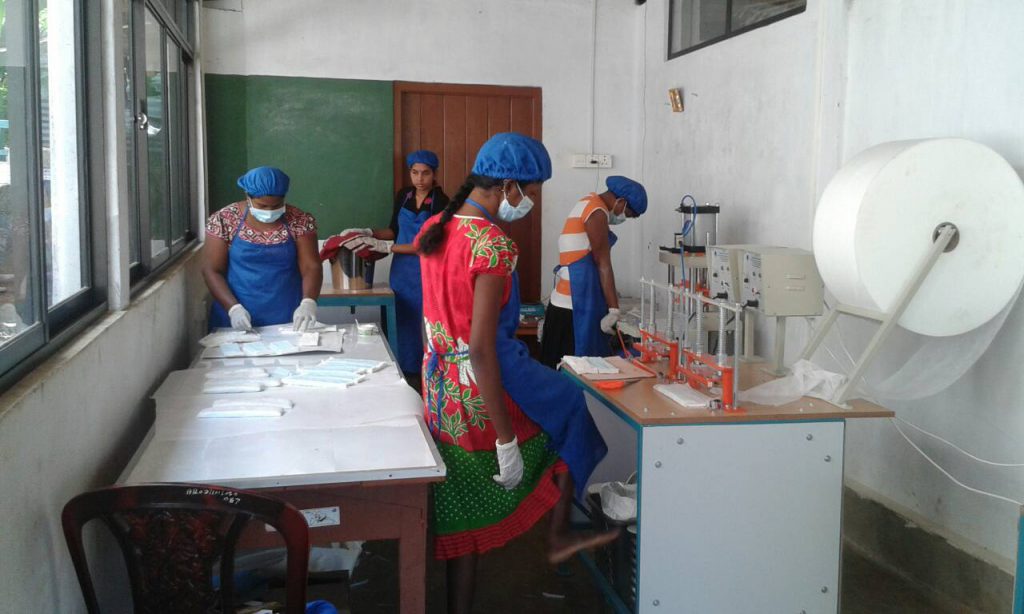
SLDFund Napkin Project.
Home Garden Projects
Many cash plants and home garden plants are available from private nurseries and government farms and generally cost up to $1.00 per plant.For planting details: Home Garden Plants for North & East by Dr. Paul Benjamin.Bee Keeping
Apiculture is a profitable and healthy venture. Beekeeping to produce local honey is a profitable sideline, or a full-time occupation. Bee hive and bee colony, tools and accessories technical training, and financial management training for business development will be provided. We are in the planning stages of introducing the honey production as a small business industry.Poultry
Funds and guidance will be provided to purchase and maintain twenty egg laying hens along with cage and a month of feed. They will be productive from day one to generate income to beneficiary. Income from sale of eggs may be sufficient to bring them above poverty level. Setting up a poultry unit cost is $300 to $500.
Mr. Thennavan with our Chairman
These upgraded chickens are generally disease resilience; heat tolerance and the ability to utilize poor quality scavenge feeds, attributes essential for achieving sustainable production in low input-output production systems. Technical training and financial management training for business development will be provided. Setting up a poultry unit cost around $500.00.
We have funded a poultry unit with 200 chickens in Kilinochchi which will also be our breeding stock to provide the necessary chickens to our beneficiaries. We have also purchased two battery powered incubators.
Goat Stud Service
Funds and guidance to purchase two Jamnapari goats known for their meat and milk to establish a goat stud service center in rural areas will be provided to selected beneficiary. Initially, the project will provide some support in terms of supplying feeds or maintenance cost for few months in addition to housing. Technical training and financial management training for business development will be also provided. Setting up a goat stud service center generally cost around $500.00
Nanny Goat
Funds and guidance to purchase four or five nanny (female) goats to establish a milking herd to selected beneficiary. Generally, the nannies should be milking in about six months and any young goats (kids) could be sold thereafter and they could replace the milking nannies by purchasing new ones themselves. Initially, the project will provide some support in terms of supplying feeds or running cost for few months in addition to housing. Technical training and financial management training for business development will be provided. Setting up a nanny unit generally cost around $300.00
Education
Many students, especially those from privileged schools, generally have not engaged in meaningful community service work that enhances their educational experience. These service experiences are fundamental to their future outlook on life. Many students also lack the basic understanding of conservation principles.
Funds will be provided to schools to organize groups of 16 to 18 year old students for weekend outings into disadvantaged communities to volunteer their services. They can have hands on experience and appreciate the value of volunteerism. Students learn more about disadvantaged community by becoming actively involved and which may also lead to self discipline. The activities could include but not limited to helping with agriculture, animal husbandry, renovating huts, cottages, and homes, etc.
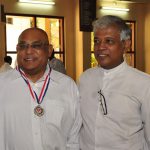
Rev. Gnanaponrajah with our Chairman
We have initiated the volunteer service program in collaboration with St John’s College principal Rev Jameson Gnanaponrajah, to organize groups of students for weekend outings into disadvantaged communities to experience and appreciate the value of volunteerism.
We have initiated the conservation club as a joint venture with St John’s College principal Rev Jameson Gnanaponrajah.
Funds will be provided to schools to organize conservation clubs for 8 to 12 year old students. They can learn the basic concepts of conservation. This may include the purchase of books and other teaching tools and day trips to nature facilities, etc.
Funds will be provided to grow fruit trees such as oranges, papaw, banana, and other fruit-bearing trees in schools or community centers. This may educate the children on the basic concept of horticulture and provide nutritious fruits for them.
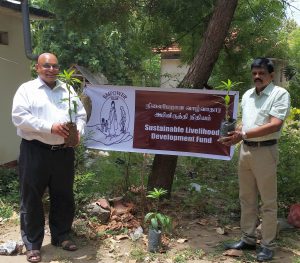
Mr. Murugavel with our Chairman
We have provided 215 Villard – grafted mango plants to be planted in 104 schools in Kilinochchi Zone area to Mr. K Murugavel, Zonal Director of Education.
Diversified Activity
Funds will be provided to:
- Organize educational lecture series on home gardening and financial management to disadvantaged communities
- Individuals in a family as micro-grants for travel and incidental expenses for any of the above projects
- Communities for fresh water and irrigation projects such as digging wells, drainage, electric pumps, etc
- As interest free loans to sustain existing projects that need capital to expand or unexpected financial shortcoming